

game mechanics
Here you'll discover how the mechanics of NARUTO Mythos TCG truly work: a guide designed both to help you play with confidence and to be consulted whenever a complex situation on the board calls for a precise answer.
Effect types
The difference between Instant ↯ and Continuous ⧗ effects
Go to the section →
Timing and chains
How to resolve the order of effects
Go to the section →
Snapshot Targeting
How to apply effects to multiple targets
Go to the section →
Priority and control
Manage timing, priority, and control
Go to the section →
Effect Types
All card abilities are divided into two main categories:
Instant ↯ and Continuous ⧗. Recognizing them is crucial to understanding exactly when to apply them according to the Card Play Sequence above.
Instant effects ↯
INSTANT ↯ effects activate once when the card enters play. All instant effects are optional unless specified differently, for example with MUST. If you can't activate it's MUST effect, you can't play the card.
If the effect says MUST, IF ABLE it allows you to play the card even if you can't apply the effect completely, but if you can apply it, you must do it.
Example:
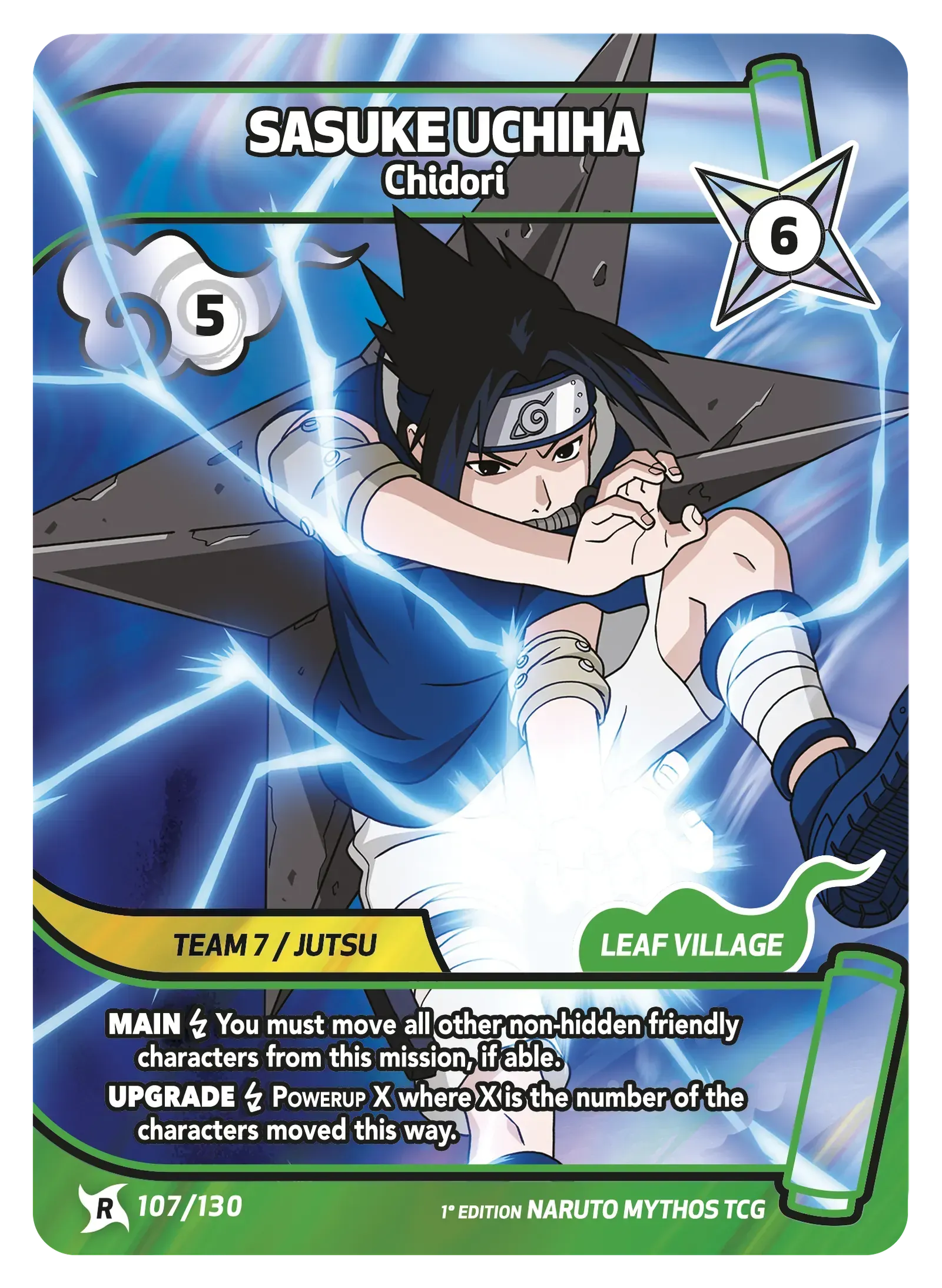
Sasuke Uchiha - Chidori says: "You must move all other non-hidden friendly characters from this mission, if able". You can play it alone in a mission and nothing happens. If there are other friendly characters in the mission you must move them, unless something prevents it.
If the card said "you must move" without "if able", you couldn't play it unless you can move all friendly characters in the mission.
You can't choose only a part of the effect:
if you decide to apply it, you must apply it all, as much as possible (ex. If you can defeat two enemy characters and there is only one legal target, you can defeat only one target. If you have one second legal target, you must also defeat that one).
Continuous effects ⧗
CONTINUOUS ⧗ effects are always active.
Most continuous effects are STATIC, meaning they are active all the time, for example, "all characters have +1 Power". Some STATIC effects have a condition to be activated, for example "if you have 3 or more characters in this mission, all your characters have +1 Power".
Core cards
What happens when there are multiple static effects on the board modifying the power or status of characters simultaneously? To avoid impossible calculations, looping bonuses and such, the game uses the "Apply to the Core stats of the card" rule, which means taking a picture of the board and applying everything at the same moment to the cards without considering other static effects. The Core Power is the printed power plus power tokens.
When you have to apply multiple static effects, they get applied all simultaneously, not one by one, to the CORE stats of the card, meaning the card with its power tokens, ignoring all other static effects.
Example:
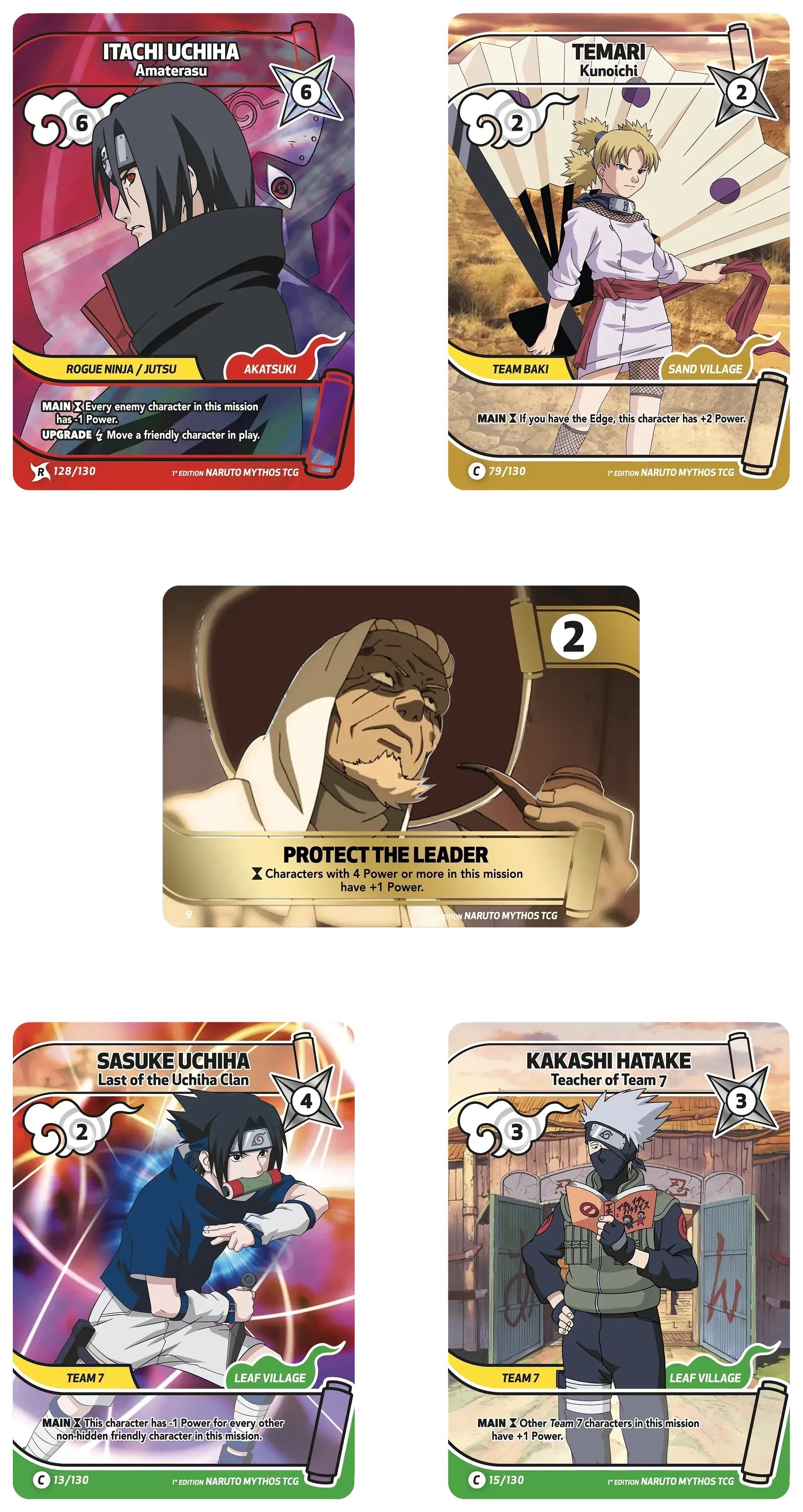
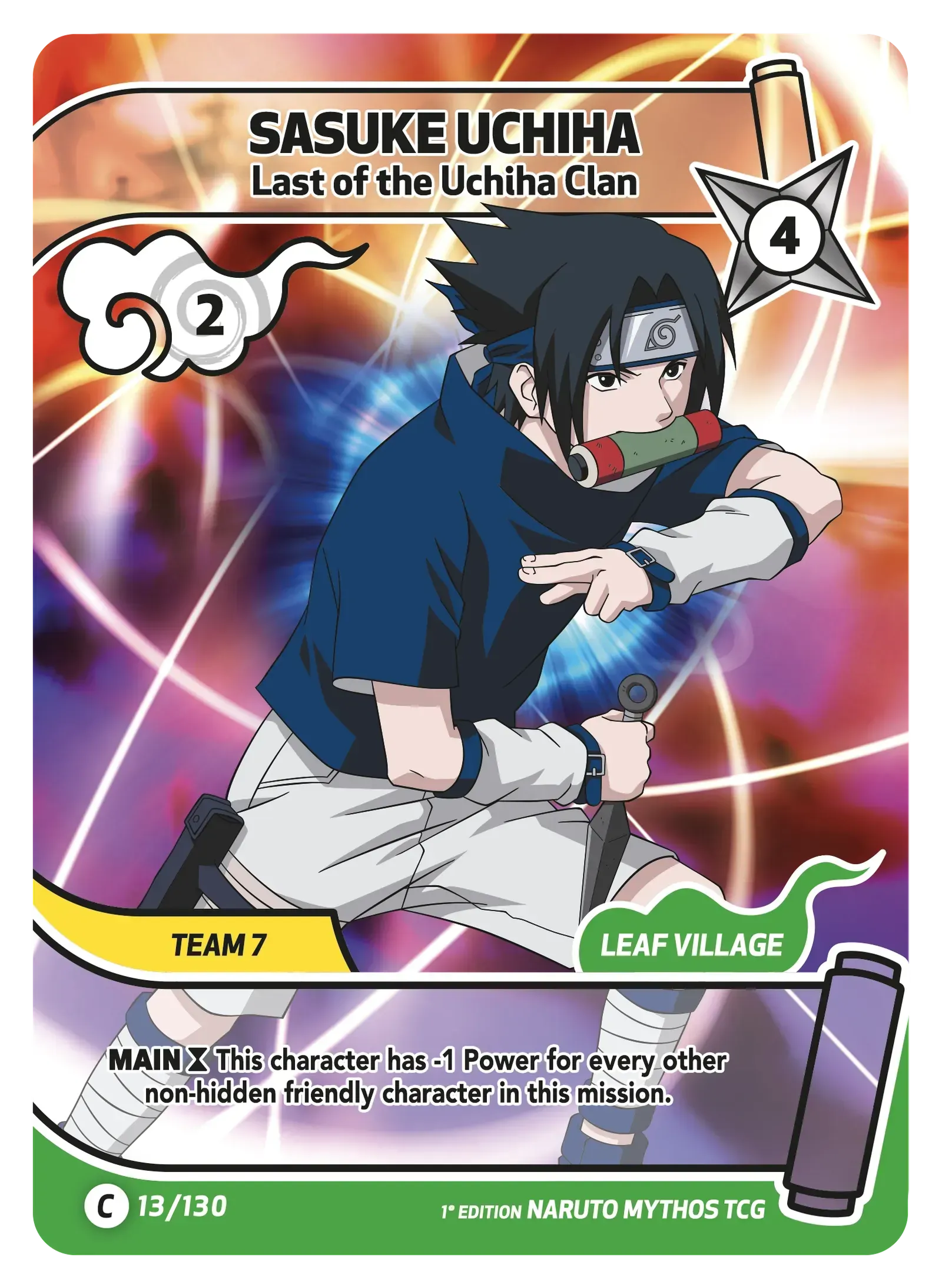
In the mission Protect the Leader there are for player A Sasuke Uchiha (Last of the Uchiha Clan) and Kakashi (Teacher of Team 7) with a power token received previously from another effect. On Player B side there is Itachi Uchiha (Amaterasu) and Temari - Kunoichi. Player B has the Edge
To determine their Power, apply simultaneously all static effects to the situation prior to static effects. So Sasuke starts as a 4 and gets: -1 for a friendly character in the same mission; +1 for Kakashi (Leader of Team 7), +1 for Protect the leader for having 4+ power; -1 for Itachi Uchiha (Amaterasu). So he counts as a 4.
Temari receives the +2 Power bonus at the same time as Protect the Leader mission, so she is a 4 because her core power is 2, not activating Protect the Leader.
Kakashi is a core power 4, 3 +1 power token, so he receives +1 power from the mission and -1 from Itachi, ending up as a 4.
For static effects that check conditions, for example the Protect the leader mission or Rashomon, the state of the mission might change you would have to check again. The state of the mission changed means for example that a new character was played there, or a power token was applied to the mission, or a character was moved from or to that mission. A character played in another mission without any effect on this mission doesn’t change its state.
Timing and chains
Every time you play a card it generates its own effects, but it can also "trigger" the effects of other cards already on the board, creating a chain reaction. To avoid getting lost, the game uses a strict resolution sequence.
Card Play Sequence
Follow these steps from top to bottom every time you play a card:
A card is played
Check and apply simultaneously STATIC continuous ⧗ effects.
Repeat this operation after every step
Activate TRIGGERED continuous ⧗ effects due to the new card entering play. In case of simultaneous effects, the turn player decides the order.
If new effects are TRIGGERED due to other TRIGGERED effects, add them to the trigger chain resolving them one by one, starting with the most recent triggered effect and then resolving them backwards, from newest to oldest.
Apply the first instant ↯ effect of the played card.
Activate TRIGGERED continuous ⧗ effects due to the new card’s effect. In case of simultaneous effects, the turn player decides the order.
If new effects are TRIGGERED due to other TRIGGERED effects, add them to the trigger chain resolving them one by one, starting with the most recent triggered effect and then resolving them backwards, from newest to oldest.
Apply the next instant ↯ effects of the played card (if present, and repeat all the operations for every new effect).
Example of Trigger Chain
When multiple effects trigger in response to one another, a "Chain" is created. The golden rule to resolve it is:
the last effect to activate is the first to resolve. Effects that activate at the same time are resolved at the same timing, in order decided by the turn player. You proceed backwards, untangling the knot until you reach the original effect.
Effect A
Effect B
Effect D
Effect E
Effect F
Effect C
Resolution (Chain resolution):
- E + F or F + E
- C + D or D + C
- B
- A
Example with cards
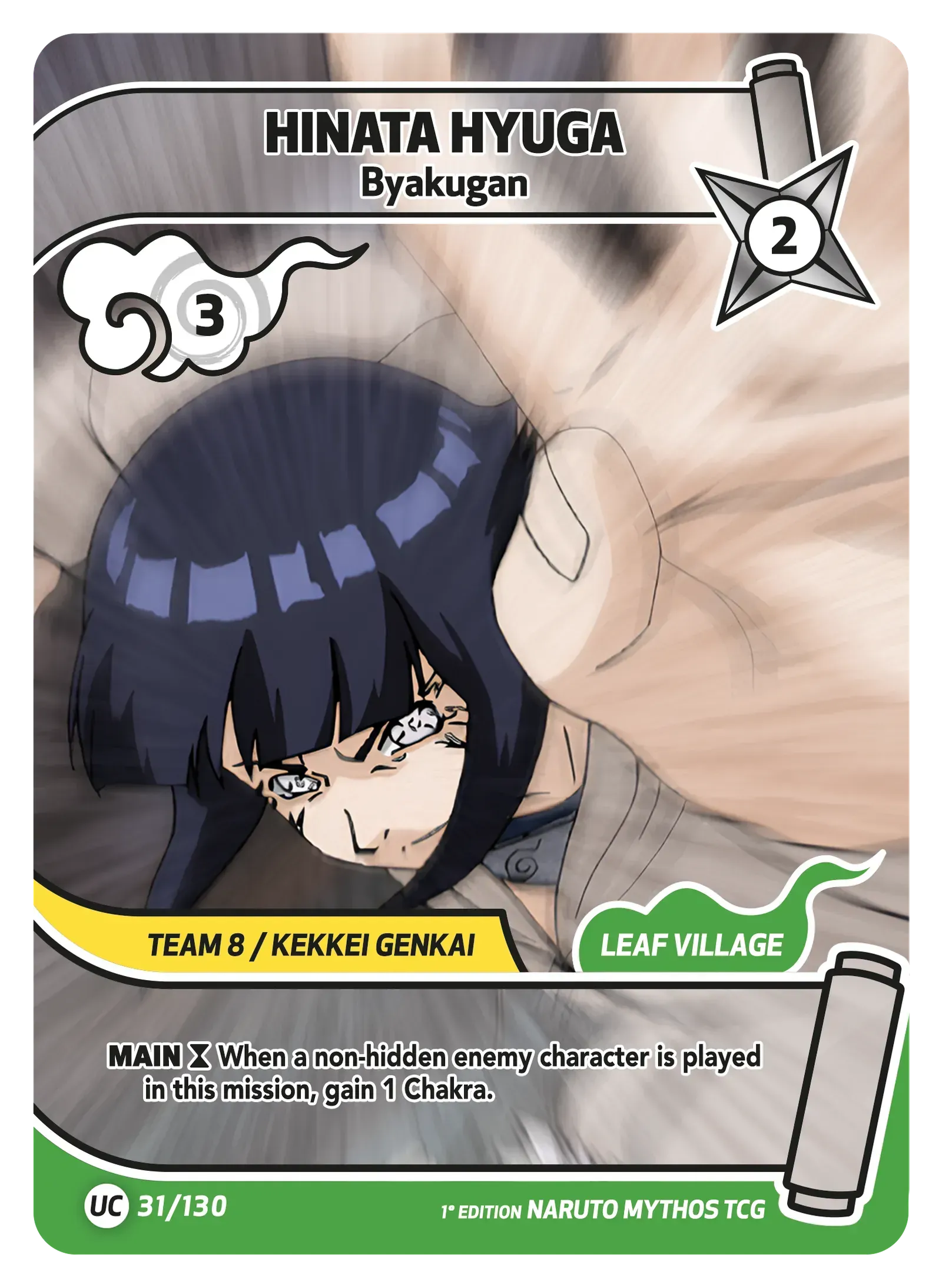
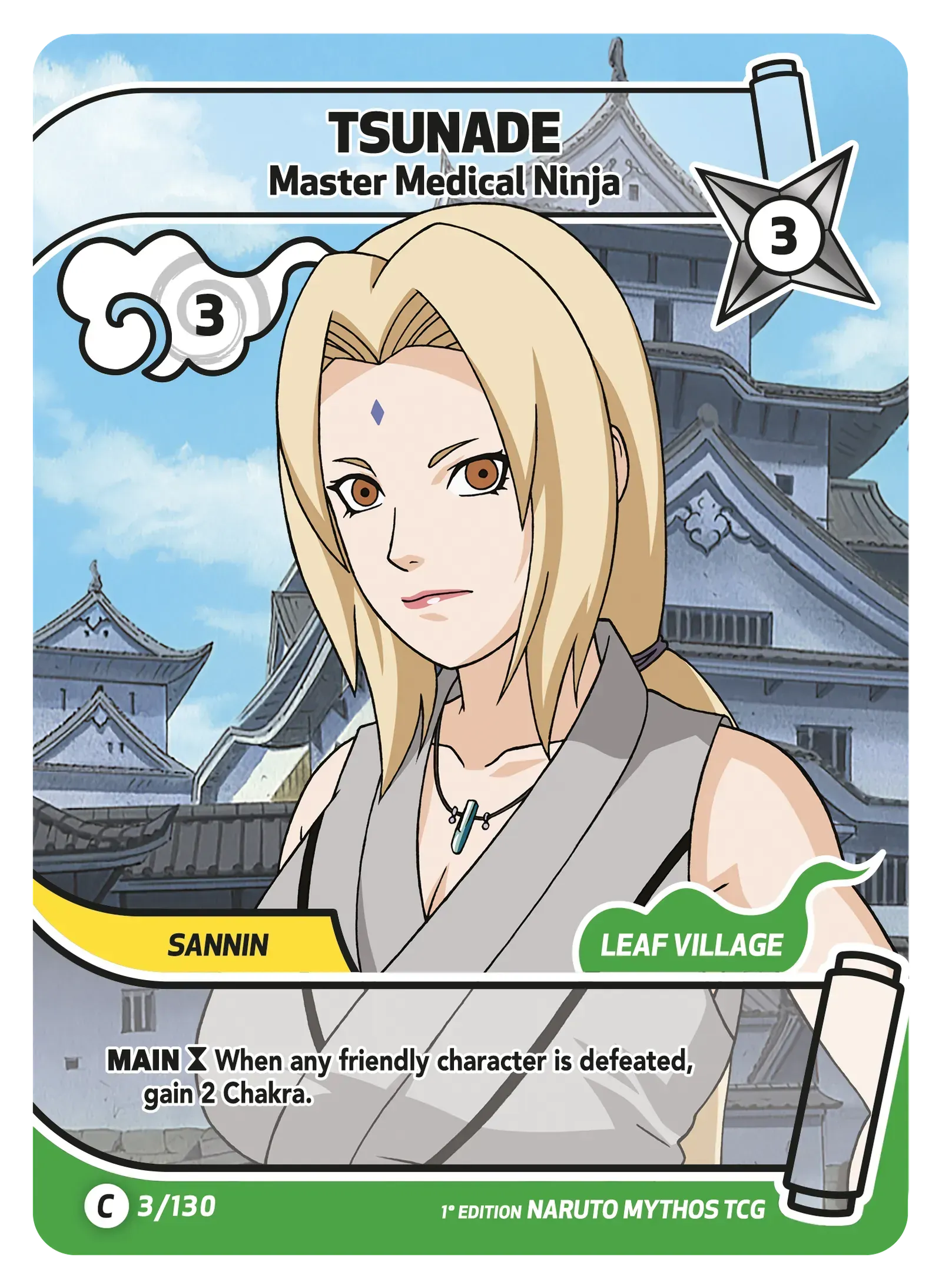
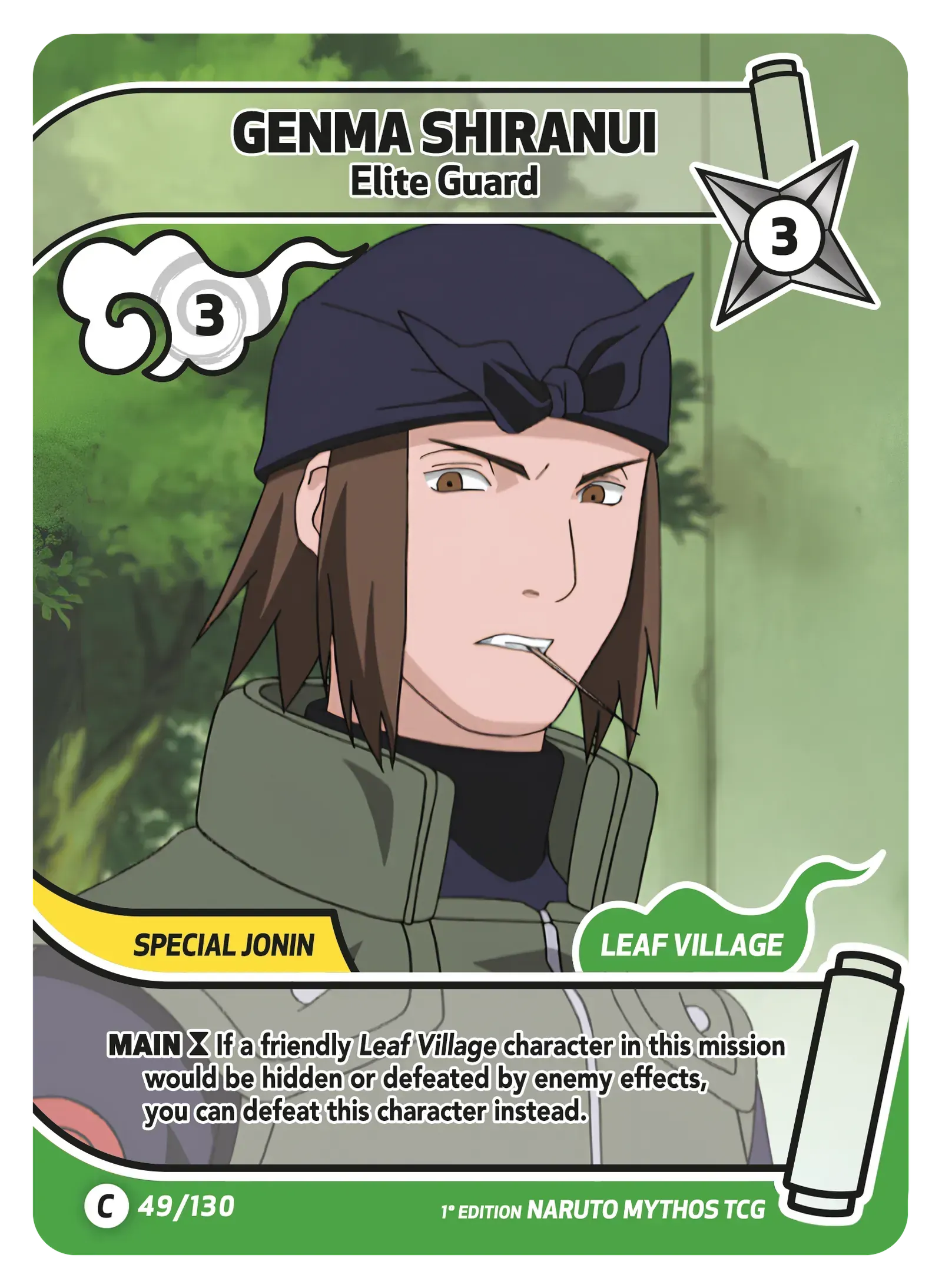
Player A
Has in the mission: Hinata Hyuga (Byakugan), Tsunade (Master Medical Ninja), Genma Shiranui (Elite Guard).
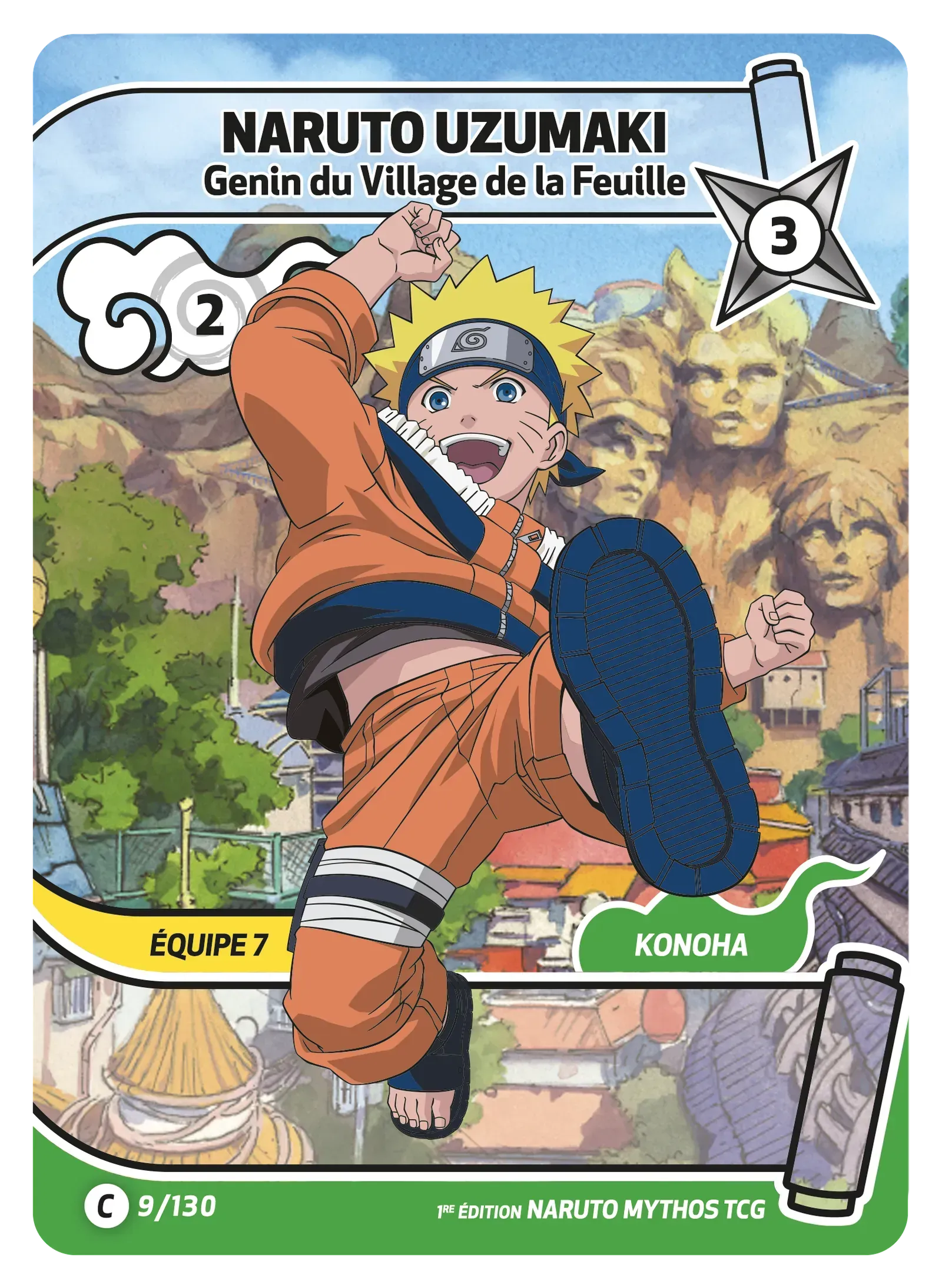
Player B
Has in the mission:
NARUTO
Uzumaki (Genin of the Leaf Village) and Sasuke Uchiha (Last of the Uchiha Clan).
1
Player B Plays Sasuke Uchiha (Heaven Curse Mark), upgrading Sasuke Uchiha
(Last of the Uchiha Clan).
Player A gains 1 Chakra due to Hinata’s effect.
2
Player B
chooses to defeat the friendly
NARUTO
and the Opponent’s Tsunade.
3
Because a friendly leaf village in his mission is going to be defeated, Genma triggers his effect and decides to sacrifice to save Tsunade. Genma is defeated.
4
Tsunade’s ability triggers because a friendly character in her mission is defeated.
Player A
gains 2 Chakra.
Player B gains 1 Chakra because of Sasuke’s static effect.
5
Player B
gets another Chakra because of
NARUTO
being defeated.
Snapshot Targeting
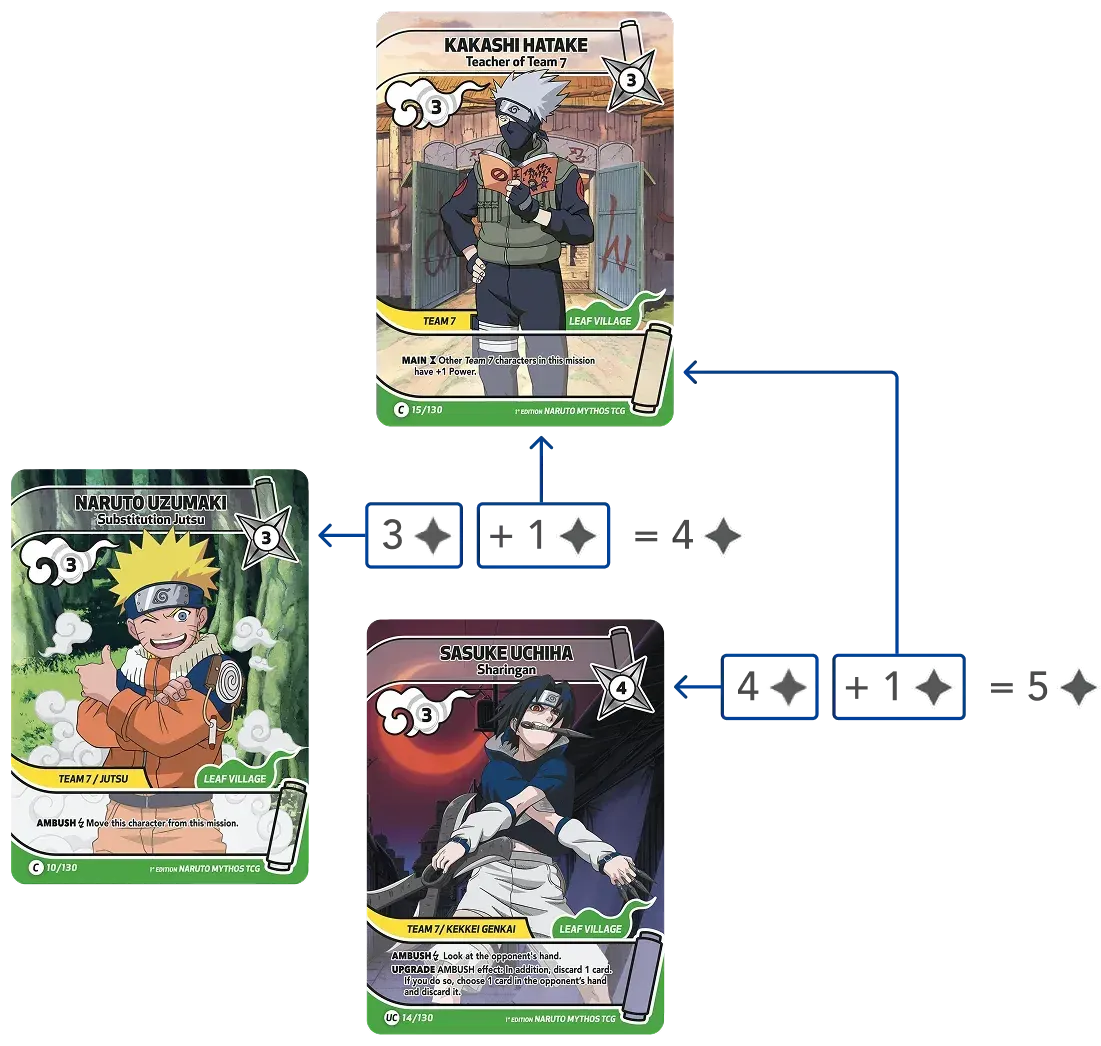
Effects that have multiple targets are applied simultaneously to all of them, so you apply them to a snapshot of the starting situation, not one by one.
1
Kakashi (Leader of Team 7) has Power 3 and gives +1 Power to all other Team 7 characters in this mission.
You have a NARUTO Uzumaki (Substitution Jutsu) and a Sasuke Uchiha (Last of the Uchiha clan) this mission, so they count as 4 and 5 Power.
2
The opponent plays Kabuto Yakushi (Nirvana Temple Jutsu) and hides all power 4 and less characters in this mission, so Kakashi and NARUTO get hidden.
3
Sasuke remains safe: although Kakashi being hidden lowers Sasuke's power to 4, this happens after Kabuto's effect has already checked for valid targets.
Priority and Control
The turn player
The
TURN player always decides orders in which simultaneous
TRIGGERED effects are applied, when it is important to do so.
Mission effects are always last. If there are simultaneous ⧗ triggered effects during a phase of the game where there isn't a turn player, like end of the round or scoring, the player with the
Edge is considered turn player.
Decider
It's important to identify the deciding player during effects. Normally during effects that allow the player who played the card to do something, that player is the deciding player (ex. Defeat all enemy characters in this mission). Effects that ask the opponent to do something make them the deciding player (ex. The opponent defeats all their characters.) This is important for operations in which order of the cards is meaningful, for example how cards enter the discard pile.
Discard pile
Discard pile cannot be manipulated during play. If an effect defeats multiple targets, who has control over the effect (decider) chooses the order.
- "Defeat all characters" means you have control over the order.
- "The opponent defeats all their characters" - means they choose the order.
No repetition
A core rule of the game states that you can never
PLAY a character in a mission if another character with the same name is already present. Likewise, you cannot
MOVE a character (friendly or enemy) into a mission if doing so would result in two characters with the same name in that mission.
However, due to interactions from other effects (such as taking control of an enemy character, returning control of it, removing the top card of an upgraded character, or playing a random character) this situation may still occur. In such cases, the newly arrived duplicate character is immediately discarded. This discard does not trigger any effects and is not considered a defeat.
Take control
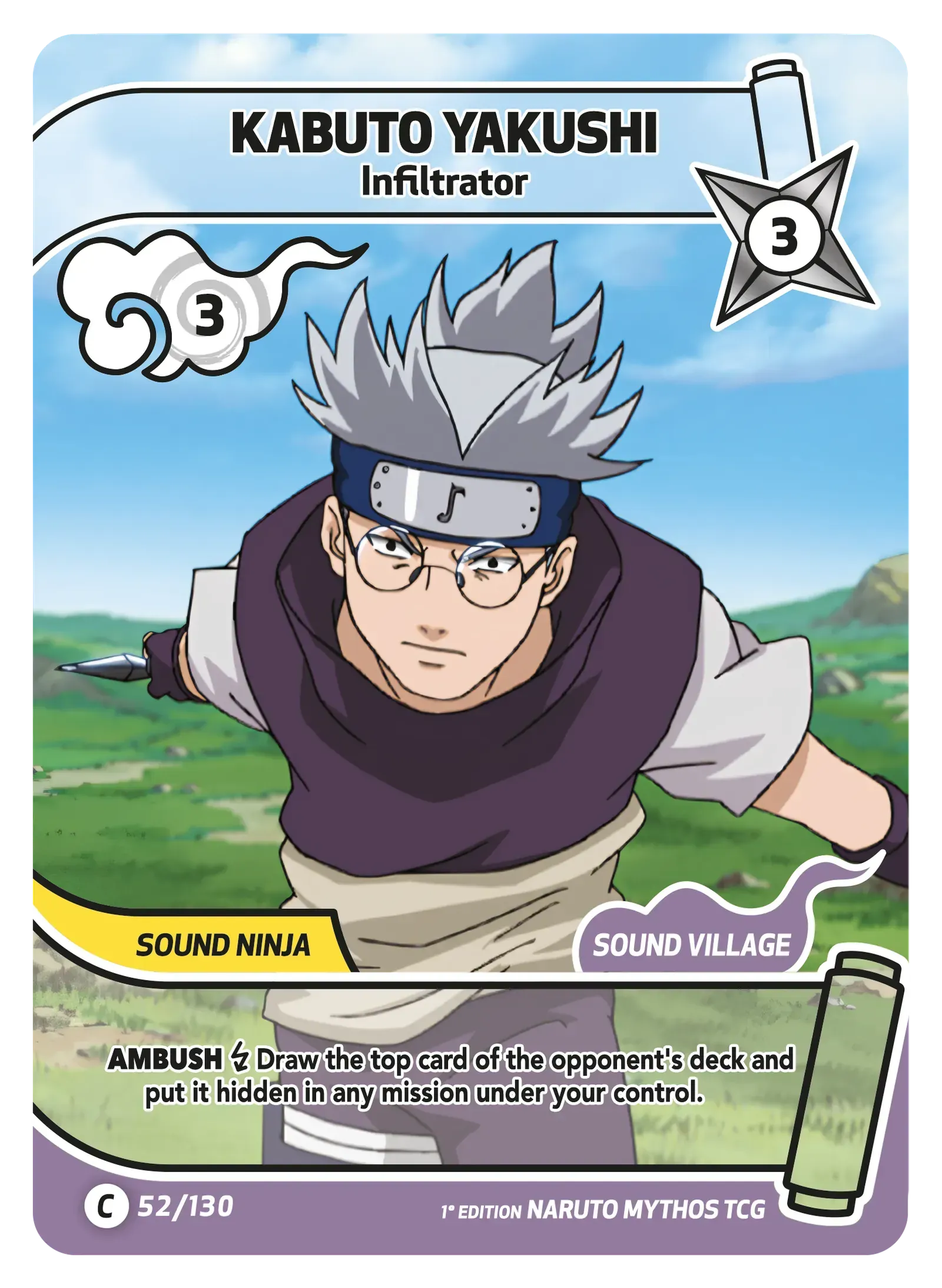
Some effects allow you to take control of a card from the opponent. Some do it from play, like Ino Yamanaka (Mind Transfer Jutsu); some do it from the top of the opponent deck, like Kabuto Yakushi (Infiltrator).
All opponent’s cards on your side of the missions are considered to be under the
Take Control rules. This means that, if the source of the control leaves play,gets hidden or gets controlled, the controlled card goes back to the opponent in its current state and position.
Example:
I play Kabuto Yakushi (Infiltrator) and take a card from the opponent’s deck and put it hidden in my mission.This happens both if the character has been revealed or not.
If Kabuto leaves play, that character goes to the opponent on the other side of the Mission it currently is in.
This happens both if the character has been revealed or not.
To understand the system better, imagine something like this: the card that allows to take control of an opponent’s card receives a CONTROLLER token. The cards that get controlled gets a “CONTROLLED ” token that follows the controlled character wherever it gets moved to, or if it changes state, for example being hidden.
In addition, if the controlled card leaves play, for example being discarded or defeated, it goes back to the owner’s discard pile. If it gets returned to hand, it goes to the owner’s hand.
Upgrading controlled and controller characters
Upgrading controlled and controller characters. You can't use controlled cards to upgrade or be upgraded over.
If a Controller card is upgraded on, it keeps the Controller condition. If it gets hidden or leaves play, you give back the Controlled card.
If the Controller leaves play and then gets played again, it doesn’t count as still controlling the card it controlled before: as soon as it left play it lost the “controller” condition that was linked to the controlled card, and the Controlled card will go back to the owner as soon as possible
How “Control” is broken and the Controlled goes back to the owner in the same state and mission:
- The controller is hidden
- The controller or controlled is defeated
- The controller or controlled leaves play, for example being returned to the deck or hand.
- The controller becomes controlled